Showing posts with label Finn Ross. Show all posts

Monday, October 9, 2017

Crossing

Crossing
2017 BAM Next Wave Festival
October 8, 2017
 
Photo courtesy of 2017 BAM Next Wave Festival
The American Repertory Theater production of Crossing was part of the 2017 BAM Next Wave Festival.  This new opera, composed, written, and conducted by Matthew Aucoin, was inspired by Walt Whitman’s diary entries during the time he volunteered at a Civil War hospital.  It explores Whitman’s essential question, “What is it, then, between us?”  The production is majestic and relevant.  Director Diane Paulus keeps everything simple and concise, allowing the music to envelope the audience and the moments to be true and personal.

Photo courtesy of 2017 BAM Next Wave Festival
From the BAM program notes, written by Matthew Aucoin:  “So, in Crossing, the Walt Whitman who walks the stage is not that familiar poetic persona.  Rather, this is Whitman as I imagine he might have been to himself, starting from a midlife crisis which prompts his radical, heroic decision to drop everything and volunteer in the war hospitals.  Naturally, this Whitman is a fictional creation.  Crossing is a musical fantasia which imagines and realizes the many forces – generosity, insecurity, longing, selflessness, bravery, unfulfilled sexual desire, a need to escape his own life, a boundless kindness – that caused a man named Walter Whitman, Jr. to forge an indelible embodiment of the American spirit in his poetry.”
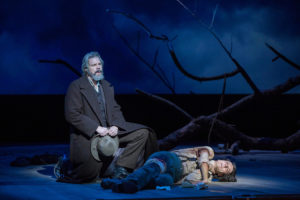
Ron Gilfry & Alexander Lewis
Photo courtesy of 2017 BAM Next Wave Festival
Ron Gilfry commands the stage as Walt Whitman.  Alexander Lewis creates intrigue in the character of John Wormley.  Davone Tines captures the audience’s attention when he tells the haunting background story of his character Freddie Stowes.

The projection design by Finn Ross brings depth and imagination to the emotional stories shared by the characters.  Jill Johnson’s choreography adds dimension to the realistic and somber hospital environment.

Crossing was presented at the BAM Next Wave Festival from October 3 – 8.  Keep your eyes peeled for additional live performances or video broadcasts.  It is well worth seeing. 

Domenick Danza

Tuesday, April 26, 2016

American Psycho, the Musical

American Psycho, the Musical
Gerald Schoenfeld Theatre
April 16, 2016

Photo Courtesy of
American Psycho, the Musical
The stark, white set of a New York apartment fills up with smoke.  We hear the rhythmic, steady pounding of a heartbeat.  The shadowy figures of a man and woman appear.  Blood splatters.  Blackout.  That is the first three minutes of AmericanPsycho, the Musical.  The tone is set.  The erotic and stylistic telling of this dark story has begun.  The production, under the brilliant direction of Rupert Goold, accurately evokes the mindset of New York City in 1989.  It is fast paced with a crispness and shine that reflects on present day values and convictions.

Benjamin Walker is captivating as Wall Street Banker, Patrick Bateman.  He skillfully carries the show with a calm demeanor, intense focus, and outstanding singing voice.  He creates a character that is real, flawed, apathetic, and identifiable.  Jennifer Damiano, who plays his secretary, Jean, lures us deeper into the dark side of this psychological tale with a sincere portrayal of naive obsession.  She catalyzes the character of Patrick Bateman, twisting the plot to an unexpected climax and resolution.

Benjamin Walker & the Ensemble
Photo courtesy of American Psycho, the Musical
The book, written by Roberto Aguirre-Sacasa (based on the novel by Bret Easton Ellis), is masterfully conceived.  The first act overflows with innuendo that generates psychological insight into the characters.  The most outstanding scene is the dinner party in Act I where the spoken dialogue is clearly the inner thoughts of those in attendance.  They blatantly blurt out the words in their heads, which should never be spoken out loud.  The effectiveness of this scene lays the foundation for the framework on which he builds the remainder of the show.  

Benjamin Walker, Jennifer Damiano, & Alice Ripley
Photo courtesy of American Psycho, the Musical
The music and lyrics by Duncan Sheik are powerful.  Some songs create a mechanical and robotic atmosphere, while others reveal the inner workings of the minds of the characters.  His best songs are in Act II.  “At the End of the Island” is biting and witty.  “A Girl Before” is hauntingly engaging.  In the finale, “This is not the End,” the main character reveals his deepest fears.  The force that has driven the plot is brought to a conclusion, and the impactful theme of the show is clearly understood.

Photo courtesy of
American Psycho, the Musical
The design elements of the production (scenic design by Es Devlin, lighting design by Justin Townsend, sound design by Dan Moses Schreier, and video design by Finn Ross) tightly blend together to create a harsh and cold atmosphere that illuminates the static noise and conflict inside the head of the main character.  Combined with the ingenious choreography by Lynne Page, the show has a mesmerizing effect on the senses. 

American Psycho, the Musical is a stunning and masterful work of theatre. 

                                                                     Domenick Danza

Tuesday, May 5, 2015

The Curious Incident of the Dog in the Night-Time

The Curious Incident of the Dog in the Night-Time
Ethel Barrymore Theatre
May 1, 2015

Photo courtesy of
The Curious Incident of the Dog
in the Night-Time
I finally saw The Curious Incident of theDog in the Night-Time.  The experience of the production far exceeded every great comment I’ve heard.  Yes, the technology is amazing, the directing is skillful and daring, and the acting is on point and authentic.  The effectiveness of the concept far exceeds any rave review, high recommendation, or Tony nomination.  The show needs to be experienced to be fully appreciated. 

Part way through the first act I realized that I was observing the play; somewhat detached while still engaged.  I was carefully watching the changing lights and movement of the props.  I was calculating the level of the relationships.  I was not emotionally connected to the characters, nor did the conflict move me or drive me to react.  Yet, when the first act ended and the house lights came up, I was stunned.  I didn’t want to move.  I needed to think through what had just happened.  I realized the depth of my engagement in the show was more intellectual and analytical than it was emotional.  This is the way the main character, Christopher, a fifteen year old with an autistic spectrum condition (exceptionally played by Alex Sharp), experiences his world.  This is the genius of the production.  The technology (set, lights, video, and sound) is brilliantly designed to give you the main character’s perspective.  All the other characters are directed through the lense of his point of view.

Photo courtesy of The Curious Incident of the Dog in the Night-Time

Understanding this allowed me to dive into the second act with enthusiasm.  It was a roller coaster ride as Christopher traveled alone on a train from his home with his father to live with his mother in London.  Once out of his comfort zone and routine, his senses became overwhelmed, and so did mine.  I found myself experiencing his journey of solving the murder of his neighbor’s dog with unstoppable resolve.  There was no fear and no emotional frenzy as deep family secrets were uncovered.  Each conflict and obstacle were treated with blind determination that made each conflict and obstacle just another stumbling block to move past. 

I was warned not to leave after the curtain call, and purposefully not told why.  I give you the same advice if you have not seen the show, but with some insight.  There was a mention during the second act that there would be an explanation for a math problem after the curtain call.  When the character of Christopher articulates his solution, it encapsulated the way he sees the world and the way the technology of the show are the workings of his mind.  This section of the show encompasses the journey of the play.

Photo courtesy of
The Curious incident of the Dog in the Night-Time
Director Marianne Elliott has created a unique theatrical experience with depth and insight.  The designer team of Bunny Christie (scenic and costume), Paule Constable (lighting) Finn Ross (video), and Ian Dickinson (sound) have created the inner workings of the mind of a person on the autism spectrum.  You will love Alex Sharp as Christopher.  He is endearing and genuine.  And nothing I or anyone else says can match the experience of this production.  See it through the eye of Christopher yourself.  Take the journey.

Domenick Danza