Showing posts with label Christopher Shinn. Show all posts

Sunday, July 26, 2020

Christopher Shinn Excels in Crafting a Brechtian Experience for the Audience in his Play Teddy Ferrara

Photo courtrsy of TCG Books
It was not that long ago that I posted on this blog about the work of playwright Christopher Shinn.  I recently read his play Teddy Ferrara, and am compelled to write about his work again.  Teddy Ferrara is a skillfully crafted play.  Mr. Shinn’s characters are truthful, distinct, and developed with precision.  His dialogue is honest and reveals the pressing needs of the characters.  The scenes are full of miscommunications, as the character engage in social games that have a lasting effect on one another.  I will say this is Mr. Shinn’s most powerful work.

The story takes place on the campus of a large state university in the northeast.  Gabe, a 21-year-old student, runs the Queer Student Group.  He just started dating Drew, who is the editor for the university newspaper.  They meet Teddy Ferrara, an awkward freshman, when he shows up late for the Queer Student Group meeting.  Gabe gives Teddy the information he missed and invites him to the group’s upcoming dance party.  After he leaves, Drew calls Teddy “a weirdo.”  Drew also expresses his jealousy toward Gabe’s roommate, Tim, who is straight.  Gabe brushes off both of Drew’s comments.

The on-campus suicide of a student, Kevin Gillman, the previous school year is beginning to get a lot of press attention.  Information has surfaced that he committed suicide because he was gay and closeted.  The Provost forms a student committee to meet with the President of the University to discuss how to change the homophobic atmosphere the LGBTQ students encounter on campus.  Gabe is a member of this diverse committee of student representatives. 

When Teddy shows up at the dance party, he tells Gabe that his straight roommate videotaped him in his dorm room having sex with someone he met on line.  Gabe is concerned, but focused on the evening’s event and does not address it any further.  Everyone else is too caught up with their own drama to notice that Teddy has isolated himself.  When Teddy commits suicide later that night by throwing himself off the same library balcony as Kevin Gillman, the homophobic atmosphere of the campus if thrown into greater scrutiny.

This play is Brechtian in structure and style.  It clearly and simply illustrates a series of actions from which the audience can draw their own conclusion.  Mr. Shinn gives the audience a bird eye view into the individual behaviors that form this community.  In doing so, he has successfully written scenes of “pure action,” as Brecht emphasized, without any moral explanation to guide the audience toward a purposeful learned outcome.  Not one of the characters seems to be aware of or sensitive to what is going on around them.  They are unaware of their contribution to the creation of an alienating environment.  None of them seems to realize they could have changed Teddy’s situation by simply including him in any one of their conversations. 

Photo courtesy of Goodman Theatre
In the notes at the beginning of the play, Mr. Shinn writes, “The design should be simple in order to maximize speed of storytelling.”  The play does not designate locations for any scene, yet the dialogue is specifically grounded in the setting, which is vital for the flow of action and development of events.  This play can almost be performed on a bare stage.  The actions are that concise and riveting.  I am in awe of Mr. Shinn’s skills in crafting this piece.  Teddy Ferrara had its world premiere at Goodman Theatre on February 11, 2013.  I hope it is produced after the pandemic so I can see a full production.  Get a copy of Teddy Ferrara and read it for yourself.

Domenick Danza  


Tuesday, May 19, 2020

The Plays of Christopher Shinn


The Plays of Christopher Shinn

Playwright Christopher Shinn
Photo courtesy of Playbill
The first play I saw that was written by Christopher Shinn was Dying City at Second Stage Theater.  I posted about it on this blog on June 23, 2019.   The play was enthralling.  Allow me to quote myself, which I have never done before.   “Mr. Shinn holds back the details, building suspense and intrigue until the characters spill out the truth.  He then takes the characters to a place of understanding, both free of what was weighing them down and newly burdened by their current awareness.”  I immediately bought an anthology of his plays an read all five of them.  Each work is distinct, yet all contain skillfully crafted dialogue and characters in search of their own truths.

Judgement Day
Photo courtesy of Park Avenue Armory
When I read he adapted Judgment Day, which was running at the Park Avenue Armory in December, I did something I rarely do.  I bought a full price ticket.  I wrote about that production in a blog post on December 14, 2019.  I won’t directly quote myself again.  I’ll just paraphrase.  In Judgement Day Mr. Shinn builds strong characters motivated by the underlying themes in Ödön von Horváth’s original play.  You empathize with their situation and feel, as they do, that there is no escape from their actions.  

Photo courtesy of
Bloomsbury Methuen Drama
Last week I read another of his plays, Against.  Of all the plays of his that I read, it is one of the more complex and enigmatic.  This is because of two skillfully crafted elements: his structure, and the creation of his main character, Luke.  In the first scene we find out this “Silicon Valley billionaire” thinks he was visited by God.  The message he received was, “Go where there’s violence.”  It is the opening line of the play and sets Luke off on his journey.  His character unravels one page at a time as we hear the adoration and suspicions of the people he comes in contact with.  The action is not fast rising, but builds the world of the play layer upon layer with each progressive scene.  The ending is unexpected, yet brings about the change that Luke was hoping to evoke.  You are left with the realization of how violence is firmly embedded within our culture.  You wonder what needs to happen to change the “status quo.”

If you are looking a good read in your time at home with no access to live theatre, I recommend reading the works of Christopher Shinn.  Do as I did, start with Dying City. His collection of plays is entitled Where Do We Live & Other Plays.  Save Against for last.  It will serve as a stunning ending to your Christopher Shinn journey. 

Domenick Danza

Sunday, December 15, 2019

Judgment Day

Judgment Day
The Park Avenue Armory
December 14, 2019

Photo courtesy of The Park Avenue Armory
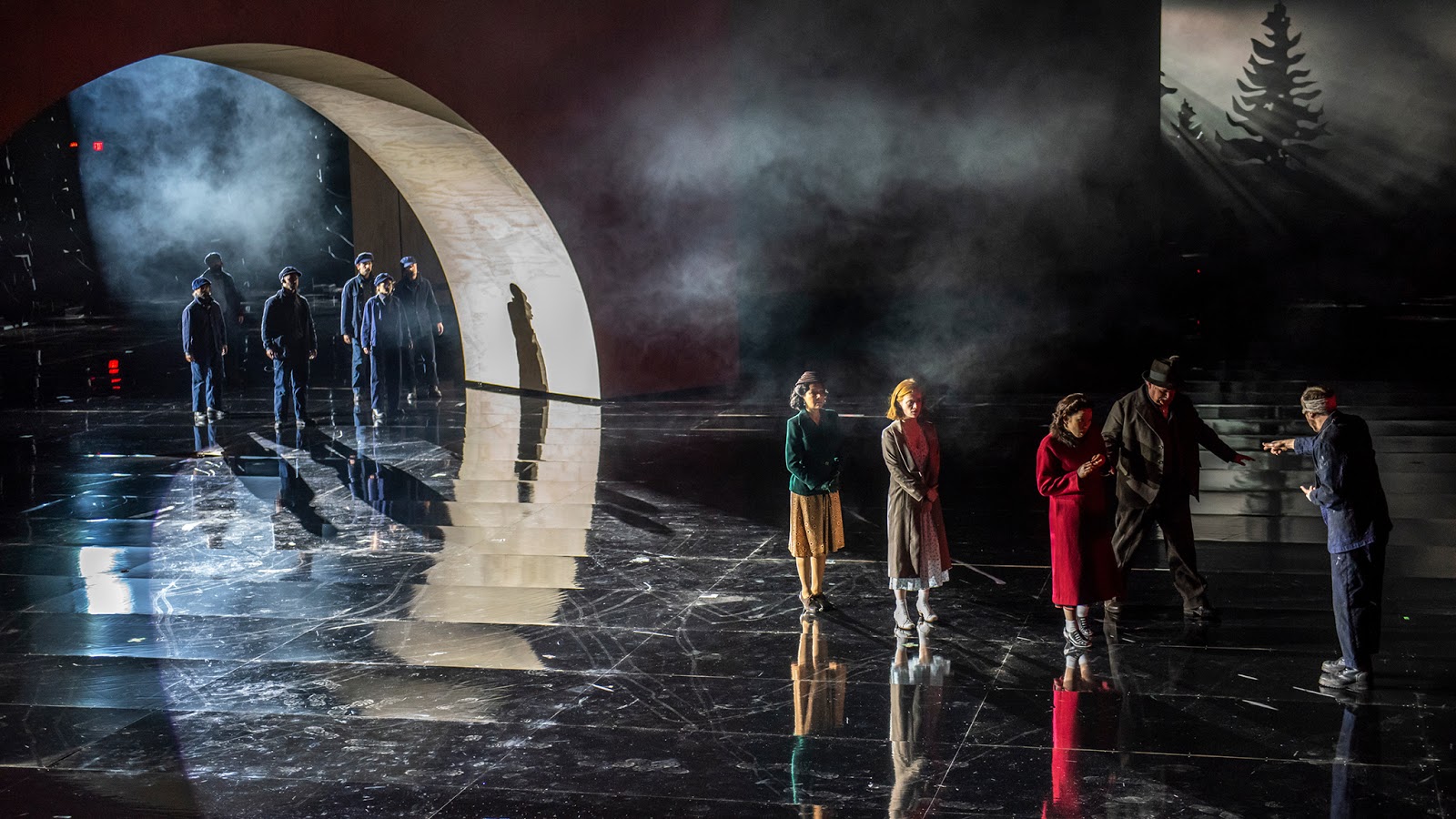
The Park Avenue Armory production of Judgment Day is spectacular.  Director Richard Jones creates an impressive atmosphere and significant impact, while keeping the action moving at an accelerated pace.  He and Movement Director Anjali Mehra maneuver a cast of seventeen and two monumental set pieces around the Armory’s vast and expansive space with grace and precision.  Christopher Shinn’s adaptation of Ödön von Horváth’s play is skillfully crafted.  The characters are strong.  The underlying themes motivate the action, which builds to a stunning climax.

Luke Kirby & Cast Members
Photo courtesy of The Park Avenue Armory
It is the 1937.  Stationmaster Thomas Hudetz (played by Luke Kirby) is respected by the people of the small town he serves.  His wife (played by Alyssa Bresnahan) is thirteen years his senior, paranoid, and the subject of distasteful gossip from the same people who admire her husband.  When she spies the Inn Keeper’s daughter, Anna (played by Susannah Perkins), flirting with Thomas while he is on the job, she is filled with jealousy.  Anna kisses Thomas, causing him to be distracted and miss the train signal.  His delay in switching the track causes an accident that kills eighteen passengers.  Anna lies to protect Thomas and save her reputation.  She claims she witnessed him switching the tracks before the train passed.  Thomas’ wife confesses what she witnessed, both the kiss and Thomas’ error.  However, her reputation in the town make her less credible.  Anna’s false testimony frees Thomas of prosecution, yet neither of them can escape the guilt that amplifies over time.

Luke Kirby & Susannah Perkins
Photo courtesy of The Park Avenue Armory
Luke Kirby transforms the character of Thomas Hudetz from a meek and vigilant civil servant to a reckless, haunted, and broken man.  While we feel for him, we are also struck by how he buys into the lie that frees him from appropriate consequences.  Susannah Perkins portrays Anna as naïve, young girl, unaware of her own emotion and influence.  The impulses that propel her actions and the affect these actions have on her self-consciousness are astounding.  She and Mr. Kirby are brilliant together.  The discovery of their passion and power combined with their inability to control these emotions are mesmerizing.

Set Design by Paul Steinberg
Photo courtesy of The Park Avenue Armory
There is a synchronicity in the Park Avenue Armory with this production, as the space ignites the energy for the cast and the cast fills the space with life.  You have to experience this production for yourself.  Lighting design by Mimi Jordan Sherin and sound design by Drew Levy and Daniel Kluger create astounding effects.  Judgment Day is playing at the Park Avenue Armory through January 10.  Get your tickets and see it for yourself!

Domenick Danza

Sunday, June 23, 2019

Dying City


Dying City
Second Stage Theater
Tony Kiser Theater
June 22, 2019

Photo courtesy of Second Stage Theater
Christopher Shinn’s Dying City is enthralling.  Mr. Shinn holds back the details, building suspense and intrigue until the characters spill out the truth.  He then takes the characters to a place of understanding, both free of what was weighing them down and newly burdened by their current awareness.

Kelly (played by Mary Elizabeth Winstead) receives an unexpected and unwelcomed visit from Peter (played by Colin Woodell).  It is the one year anniversary of her husband Craig’s death during the Iraq War, and a visit from his identical twin brother Peter brings up memories that she has finally put to rest.  When Peter shares the emails he received from Craig while in Iraq, she is forced to face truths about her husband that she did not previously know.

Colin Woodell (as Craig) & Mary Elizabeth Winstead
Photo courtesy of Second Stage Theater
Mr. Shinn masterfully structured this play going back and forth in time from July 2005 to January 2004, with the same actor playing the roles of Peter and Craig.  This allows the audience to experience Kelly’s perspective of what is happening.  It is a powerfully effective and highly engaging devise.  His dialogue is driven by conflict, uncertainty, and subtext, all coming together to deliver an impactful ending.

Colin Woodell (as Peter) & Mary Elizabeth Winstead
Photo courtesy of Second Stage Theater
Colin Woodell embodies two distinct characters in Peter and Craig.  It is impeccably clear which character his is portraying the instant he enters a scene.  Mary Elizabeth Winstead slowly peels back the layers of Kelly’s pain as details are revealed.  She is mesmerizing in this role.  The chemistry between these two actors is scintillating.  Ms. Winstead creates opposing relationships with the two characters of Peter and Craig, and the energy between her and Mr. Woodell shifts dramatically from scene to scene.

Dying City is an intriguing and powerful play, exploring the effects of post-traumatic stress on family and loved ones.  The Second Stage Theater production is of high quality, skillfully directed by the playwright.  It is playing at the Tony Kiser Theater through June 30.  Go see it!

Domenick Danza