Showing posts with label Philip Glass. Show all posts

Wednesday, April 24, 2019

King Lear


King Lear
Cort Theatre
April 23, 2019
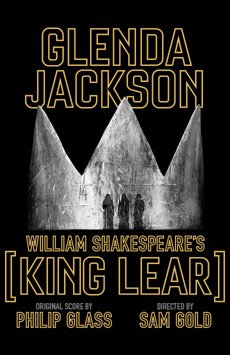
Photo courtesy of King Lear
I spent Shakespeare’s birthday watching Glenda Jackson perform the role of King Lear on Broadway.  It could not have been a better celebration.  Director Sam Gold brings the text to the forefront as he guides each actor to a deep understanding of what drives their character’s actions.  His casting is impeccable.  His grasp of effective timing is flawless.  The original music by Philip Glass enhances the build of action and calms the conflict, intensifying the emotional impact and pace of the production.  Glenda Jackson is majestic in her complex portrayal of the King. 

King Lear (played by Glenda Jackson) decides to split his kingdom among his three daughters.  Before he does, he asks each one to profess their love for him.  Goneril, the eldest (played by Elizabeth Marvel), is gracious and respectful.  Regan, the second daughter (played by Aisling O’Sullivan), poetically exceeds her sister’s pronouncements.  The youngest and favorite daughter, Cordelia (played by Ruth Wilson), is appalled by the insincere performances of her sisters, and answers truthfully and glibly.  This hurts and infuriates the King.  He disowns Cordelia and splits his kingdom in two among his ostensibly loyal and loving daughters.  The Earl of Kent (played by John Douglas Thompson) comes to Cordelia’s defense, and is immediately banished by the King.  Meanwhile, Edgar (played by Sean Carvajal) is planning on betraying his illegitimate brother, Edmond (played by Pedro Pascal) to remove him from the graces of their father, the Earl of Gloucester (played by Jayne Houdyshell).  The power struggle accelerates to full out war within the family, ending in devastating tragedy.

Glenda Jackson as King Lear
Photo courtesy of King Lear
The most dramatic and powerful scene is the blinding of the Earl of Gloucester by the Duke of Cornwall, Regan’s husband.  Aisling O’Sullivan drives this scene with fear and desperation, as her husband, played by Russell Harvard, pushes the action forward.  The scene is brutal and viscerally engaging.

One brilliant decision in double casting is that Ruth Wilson is playing both Cordelia and King Lear’s Fool.  Her vocal and physical characterizations in the contrasting roles are distinct and strong.  At one point she removes the wig she wears as the Fool.  It’s as if Cordelia is there with the King in his time of need when his other two daughters abandon and betray him.  This simple gesture speaks volumes to Shakespeare’s multi-layered theme of complicated family dynamic.

Ruth Wilson & Glenda Jackson
Photo courtesy of King Lear
The love triangle between Regan, Edgar, and Goneril is physically and sexually driven.  It feeds on the hunger for power these characters possess, which propels their action to their devastating downfall.  The battle that takes place between France and Albany as a result is simply and effectively staged.

King Lear is playing at the Cort Theatre through July 7.  Sam Gold has done an amazing job bringing Shakespeare’s themes to significant impact.  The entire cast is brilliant and powerful.  Glenda Jackson is magnificent.  Jayne Houdyshell is outstanding.  Get a ticket and see it for yourself.  

Domenick Danza

Tuesday, March 15, 2016

The Crucible

The Crucible
Walter Kerr Theatre
March 12, 2016

Photo courtesy of The Crucible
Director Ivo Van Hove exceeds all expectations with the Broadway production of Arthur Miller’s classic The Crucible.  His concept transcends all time periods and illuminates Mr. Miller’s intention by transferring its relevance to our present day struggles.  The structure of the script and majesty of the words are magnified under his direction.  The cast is superb.  They are viscerally connected to the material and one another.  They draw the audience in for the totality of the experience.


Saoirse Ronan & Ben Whishaw
Photo courtesy of The Crucible
Ben Whishaw’s portrayal of John Proctor is honest, bold, and stark.  His chemistry with Saoirse Ronan’s Abigail Williams is electric.  Ms. Ronan’s character manipulates the events of the play with a captivating confidence and composure.  This makes tangible what Elizabeth Proctor declares to her husband, that there exists an unspoken “promise” made during intimate acts between a man and a woman.  Sophie Okonedo brings a new dimension to Elizabeth Proctor that rings true.  Her performance reverberates with a deeper level of Arthur Miller’s subtext.  Bill Camp is remarkable as Reverend Hale.  There is a gradual peeling away of his understanding of the events, which causes a clearly motivated transition in his conviction.  The devastating effect this has on his ego and belief system is blatantly expressed.  Jason Butler Harner authentically reveals a vulnerable, petty, and insecure side of Reverend Paris that clearly illustrates the kind of unrest that exists within a community in order to justify the extreme reaction the events generate.  Tavi Gevinson is wildly constrained as Mary Warren.  Ciaran Hinds commands the stage as Deputy Governor Danford.  

Photo Courtesy of The Crucible
at the Walter Kerr Theatre
The design of the production is powerful.  The play preaches black and white issues, good vs. evil, God and the devil.  There are no grey areas in these debates, yet the design is all shades of grey.  The scenic design, by Jan Versweyveld, is a unit set that evokes a classroom from the 1950s with hints and accents from earlier decades as well as the present.  The costume design, by Wojciech Dziedzic, also transcends time period with disheveled catholic school girl uniforms, conventional overcoats, and unrestricted trousers.  The lighting, also designed by Mr. Versweyveld, allows the space to change as the sun rises through the windows, birds swarm and disperse, and the devil blows in from the outside.  The original score by Philip Glass enhances every moment, whether it be intimate or jarring.

Ivo Van Hove’s work needs to be experienced first-hand.  You need to sit in the theatre and hear how words suddenly have a different meaning when heard within his context.  He has an uncanny ability to strip down distraction so that every word of the playwright has a strong and clear purpose.  In this production there are a few jaw-dropping images that encapsulate bold thematic messages: a homogenous classroom, a young girl floating in midair, a wolf crossing the stage and staring out at the audience.  You must see it yourself to feel the powerful impact of his work. 


Domenick Danza