Showing posts with label Second Stage Theatre. Show all posts

Wednesday, August 24, 2016

The Layover

The Layover
Second Stage Theatre
Tony Kiser Theatre
August 21, 2016

Photo courtesy of Second Stage Theatre
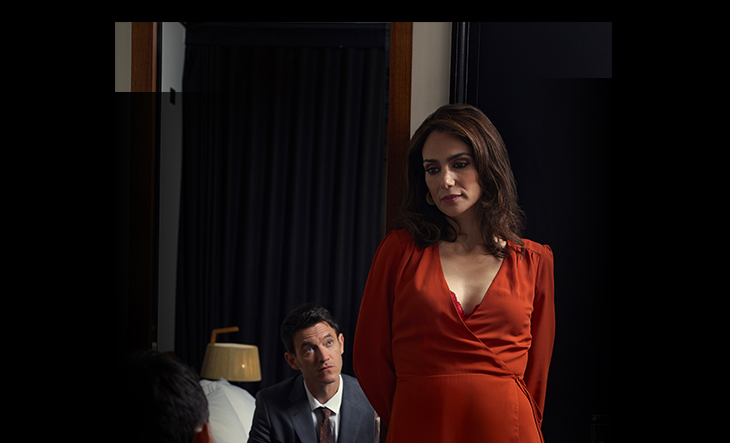
The Layover is a thought provoking play presently running at Second Stage Theatre.  Director Tripp Cullman focuses the actors on creating strong, realistic relationships that ring true and evoke empathy.  Leslye Headland's script is well structured, full of unexpected turns, and driven by clear, crisp dialogue. 

Shellie (played by Annie Parisse) and Dex (played by Adam Rothenberg) meet on a flight from Chicago to New York.  When the flight is cancelled and passengers are put up in the airport Marriott, they have a one night stand before going back to their normal lives.  They are both unable to get the other one out of their thoughts.  Finally, one of them hires a private investigator to track the other one down, and finds that everything that was said was a lie.
Adam Rothenberg & Annie Parisse
Photo courtesy of Second Stage Theatre
The scenic design, by Mark Wendland, stylistically divides the expansive space of the Tony Kiser Theatre to allow concentrated focus during the more intimate scenes.  He also splits the space so that scenes in separate locations can be delivered simultaneously.  Mr. Cullman effectively stages these parallel scenes so the characters can stare at each other across time and distance.  This heightens the theme of how certain experiences stay alive in our minds for extended periods of time.  This premise is explored through the point of view of the two main characters and Shellie’s father (played by John Procaccino).  The theme is strong, relatable, and prolifically expressed.  It is further enhanced through lighting design by Japhy Weideman and video design by Jeff Sugg.

Amelia Workman, Quincy Dunn-Baker,
Arica Himmel, & John Procaccino
Photo courtesy of Second Stage Theatre
The chemistry between Annie Parisse and Adam Rothenberg is palpable and visceral.  Both actors hook you in scene one, and skillfully transition your attention as the deeper layers of their characters are revealed.  There are also strong performance from John Procaccino, Amelia Workman, Quincy Dunn-Baker, and Arica Himmel.

The Layover is running at Second Stage Theatre through September.  The ending has some mystery and provides discussion of the characters’ true motivations and sense of reality.  See it with a friend and prepare for an in depth conversation afterwards.


Domenick Danza

Saturday, February 13, 2016

Smart People

Smart People
Second Stage Theatre
Tony Kiser Theatre
February 7, 2016

Photo courtesy of Second Stage Theatre
I immediately bought a ticket to see Second Stage Theatre’s production of  Smart People because it is written by playwright Lydia Diamond.  I studied playwriting with her at Chicago Dramatists a number of years ago.  She focused on teaching how to write realistic and riveting dialogue.  Her script overflows with this specialty.  Her dialogue connects the characters on a visceral level, creates compelling relationships which leads to strong conflict, and draws your attention deeply into what drives the play forward.  The production has a few flaws, but Lydia’s writing is sharp and detailed.

The title speaks for itself.  The play is about
Joshua Jackson & Tessa Thompson
Photo courtesy of Second Stage Theatre
four smart people.  Brian (played by Joshua Jackson) is a Harvard professor conducting a study on racism, particularly how a person’s brain reacts when seeing images of people of different races.  Jackson (played by Mahershala Ali) is a surgeon immersed in his residency while simultaneously running a clinic for people at risk.  Ginny (played by Anne Son), also a Harvard professor, is a psychologist who specializes in working with Asian women adapt to American society.  Valerie (played by Tessa Thompson) is an actress who cleans houses to pay off the extreme debt from graduate school.  The lives of these four very smart people intertwine as they emotionally relate and respond to one another based on their racial upbringing, self-image, and stereotypical expectations.  The deeper level of conflict surfaces when they choose to directly share their points of view on race relations.

Tessa Thompson & Mahershala Ali
Photo courtesy of Second Stage Theatre
The four powerhouse actors skillfully deliver these multi-dimensional characters with energy and vitality.  Their relationships are true and their emotional portrayals honest.  Unfortunately, there are times when they move in and out of the light.  Jason Lyons made some very bold choices in his lighting design, yet it does not always illuminate the playing areas completely.  The projections, designed by Zachary G. Borovay, create a strong atmosphere, yet spread over the set in a way that distorts the images.  Scenic design, by Riccardo Hernandez, utilizes the vast stage at the Tony Kiser Theatre, yet take away from the impact of the more intimate scenes.

Smart People runs at Second Stage Theatre through March 6.

Domenick Danza

An Afterthought:

When I got to the box office to pick up my ticket, the matinee had just let out.  There was a group of women heavily into a conversation about the social stereotypes and racial bias the show presented.  Since I just read a very poor blog review about the show, I listened into the discussion to get a different mindset before viewing the performance.  The women were committed to their points of view and impassioned by how the show broadened their frame of understanding. 

When I left the theatre that evening, I found myself agreeing with a few comments I heard earlier, yet I did not think the play made a strong statement about race in America.  The play did resonate with me, and after a few days of thinking about it, I realized that the depth of the characters and juxtaposition of the situations made a stronger statement than I had originally realized.

The two male character, one white and on black, are both frustrated with a specific work situation.  When each character voices their frustration, they face similar repercussions, yet are viewed very differently.  There is a strong commonality to their frustration, yet these two very intelligent, well-educated, hard working men cannot see beyond their own self-image and racial bias in order to bond over their situations. 

Playwright Lydia Diamond
This is one example of the subtle and powerful style in which Lydia Diamond chose to write this play.  There is a lot there, under the surface.  It is the purpose of theatre to make us think.  A catharsis occurs when we are able to view ourselves and the world differently after a shared experience.  Smart People is that kind of play.  See it if you want to understand yourself differently, but don’t expect it to be handed to you with ease.  You’re going to have to think, and that’s what makes good theatre.

Wednesday, June 17, 2015

The Way We Get By

The Way We Get By
Second Stage Theatre
Tony Kiser Theatre
June 13, 2015

Photo courtesy of Playbill &
Second Stage Theatre
I was very excited to be seated in the second row center to see Amanda Seyfried in The Way We Get By.  I opened my program and there it was.  The dreaded insert.  “At this performance the role of Beth will be played by Clea Alsip.”  The curse of the matinee performance.  I was disconcerted, hostile, furious.  Should I march to the box office and scream, “Refund!” and demand my TDF discount ticket price back?  “Wait,” I thought, “This is a NeilLaBute play at Second Stage Theatre.  I know it is going to be good.”  And it was!

The play was a roller coaster ride of emotion as Doug (Thomas Sadoski) wakes up in the middle of the night in the apartment of Beth, a girl he hooked up with (Clea Aslip… who delivered an excellent performance).  He is agitated and paces uncomfortably in his boxer shorts, and downs a bottle of smartwater.  The awkwardness accelerates when Beth enters from the bedroom wearing his vintage autographed Star Wars tee shirt, wondering why he left her alone in bed.  The one night stand banter plays back and forth until Doug hits an emotional wall.  Playwright Neil LaBute skillfully approaches and retreats from this wall throughout the play as Doug and Beth’s history is excruciatingly revealed.  Director Leigh Silverman intrigues the audience by building and releasing the tension between the two characters right up to the very end of the play.

Thomas Sadoski & Amanda Seyfried
in The Way We Get By
Photo courtesy of Second Stage Theatre
Scenic designer, Neil Patel clearly shopped at IKEA for every piece of furniture and knick knack on the set.  This might sound like a critical put down, but it is not.  He created the “perfect” setting for Doug and Beth’s coming together and facing their deepest fear.  The neat and orderly Manhattan condo with everything geometrically matching and in its place is an ideal backdrop for a rebellion against the norm.

Toward the end of the play, Doug says that the way people get by is to run and hide from what they want when they fear they cannot have it.  Neil LaBute takes us on a journey into the freedom that comes when you make a decision that is right for you regardless of what people will say, tweet, or politicize.

Clea Alsip
Photo courtesy of broadwayworld.com
I am still disappointed that I did not see Amanda Seyfried, especially from the second row.  I did, however, leave the theatre feeling elated from the cathartic experience of an extremely well written, directed, and performed work of theatre.


Domenick Danza

Tuesday, March 3, 2015

Between Riverside and Crazy

Between Riverside and Crazy
Second Stage Theatre
February 20, 2015


      Photos courtesy of Second Stage Theatre
I finally saw Between Riverside and Crazy, and am sorry I waited so long.  I saw advertisements for months, and read a very good review when it played at The Atlantic Theater Company this past summer and fall.  I read that the Second Stage Theatre’s production was a well-produced continuation of that run with mostly the same cast.  I sat in the theatre, waiting for the show to start, listening to the peculiar meditation-style music and realizing that from where I was sitting I was not going to be able to see all the action of the play.  The set was an interior with multiple rooms that were not in full view from my seat in house left.  I felt joy and excitement when the lights dimmed, the music gained some bass and rhythm, and the set spun on turn table to reveal all three rooms of the apartment, bringing the action down stage center.  I was not the only one to applaud Walt Spangler’s realistic, dilapidated, high-ceiling rendition of a Riverside Drive apartment.  Before a word was spoken, this set pulled me into a realistic and stark world that prepared me for the genuine depiction of the human experience that was to come. 


Stephan McKinley Henderson, Victor Almanzar, and Ron Cephas Jones 
in "Between Riverside and Crazy." Photo: Carol Rosegg
 Act I started with sharp dialogue that defined the characters right off the bat.  The main conflict was introduced in scene two as the backstory of the main character, Pops, played flawlessly by Stephen McKinley Henderson, was revealed.  The action dramatically rose at the end of the first act as Oswaldo, played meticulously by Victor Almanzar, goes off his sobriety and gets violent.  I took a minute to reflect during the intermission and realized that I was deeply involved in the world of this play.  It was real and topical.  Each point of view of the conflict was expressed so clearly that I was able to see the push and pull within each of the characters as their struggle and debate kept the action of the play moving forward.  In the second act a new character was introduced that turned the plot around, caused the conflict to explode, then calm, then pounce voraciously.

The blurb I had read for months about this play says, “City Hall is demanding more than his signature, the landlord wants him out… the struggle to hold on to one of the last great rent stabilized apartments on Riverside Drive collides with old wounds…”  This made me think the play was about the gentrification of New York City.  It is not about that at all.  It is about integrity and pride, healing and second chances.  It is not about the apartment.  Playwright Stephen Adly Guirgis (well known for his play The Motherf**ker with the Hat) skillfully crafted an edgy world full of grit and warmth.  Director Austin Pendleton peeled away every layer of that world with actors who delved into themselves and connected to one another with an amazing depth of reality and truth.

This is an important play... a must see!  Three cheers to Second Stage Theatre for mounting The Atlantic Theater Company’s production and keeping it alive.  


Domenick Danza